Shoppers add to cart, then disappear?
A shopper is torn between two products. They don’t know which size to pick, or whether this model works with the one they already own. If they can’t find the answer in a few seconds, they open another tab and check Amazon. Meanwhile, your support team is answering the same question for the tenth time today.
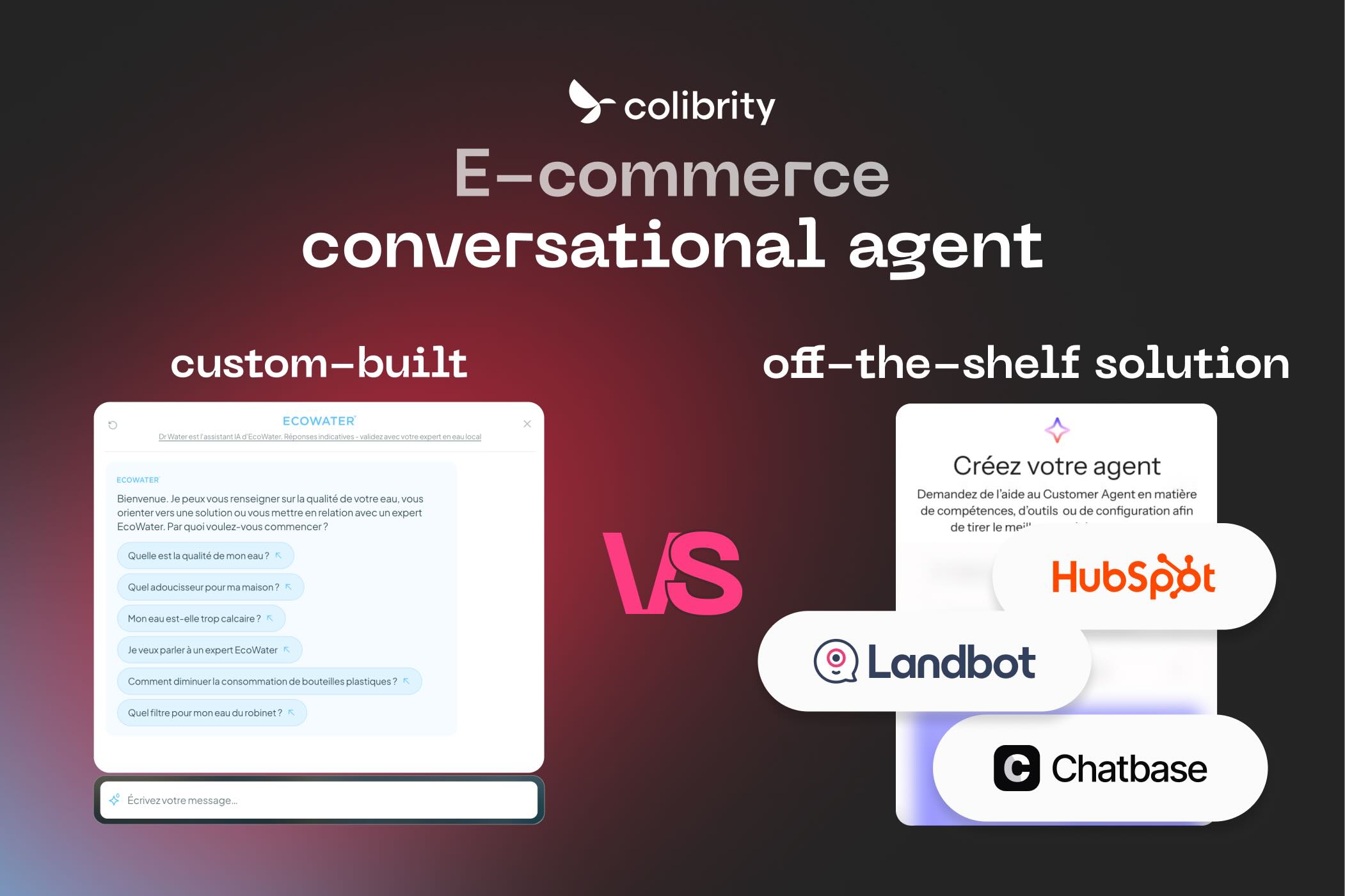
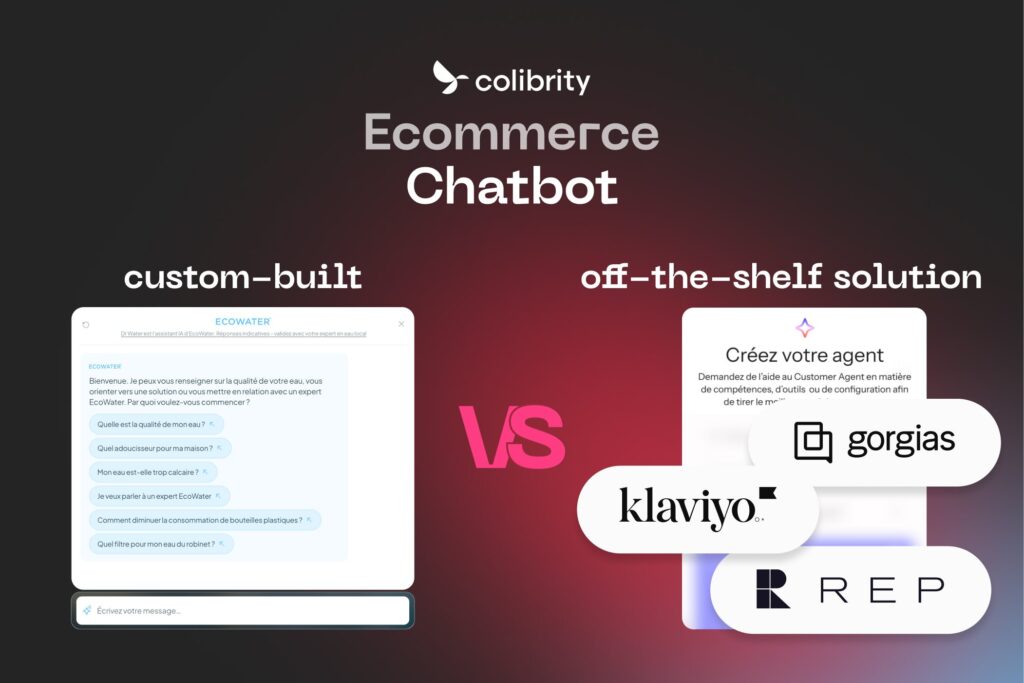
An AI chatbot for ecommerce plays the role of your best in-store sales associate. It understands what the shopper is looking for, recommends the right product, reassures them before checkout and suggests what goes with it. You can have one custom-built for your store, or use an off-the-shelf tool, usually built into a CRM or a helpdesk like Klaviyo, Salesforce or Gorgias, or a standalone app like Rep AI. This article compares the two approaches and helps you choose. For budgets, see How much does a custom AI chatbot cost?
Custom AI chatbot vs. off-the-shelf: the key differences
Several major ecommerce players now offer their own AI agent: Klaviyo, which has more than 205,000 paying customers, Salesforce with Agentforce, Gorgias, Shopify, and specialized apps like Rep AI. These tools serve brands of every size, and most of them go live quickly. They run on their own rules, their own ecosystem and their own interface. A custom AI chatbot runs on yours.
| Custom AI chatbot | Off-the-shelf tool (CRM, helpdesk, SaaS app) | |
|---|---|---|
| What it brings | A buying journey modeled on your business, custom UI and UX built into the site (immersive design, 3D avatar possible), widgets designed to convert (configurator, comparison tool, size guide…), connections to your tools whatever the vendor (as long as they have an API), free choice of AI model, easy A/B tests, fully customizable analytics, code you own and hosting you control | Fast setup, native access to the data already in the tool (customer profiles, orders), vendor updates |
| Limits | An upfront budget and a few weeks of design and development | Logic and features set by the vendor, a chat interface you can customize only within the vendor’s limits (colors, logo, CSS, or development inside its ecosystem), dependence on its ecosystem (ecommerce platform, CRM), usage-based or volume-tier billing (except free options like Shopify Inbox), advanced customization that usually takes a developer |
| Best for | Brands with a specific buying journey: technical or configurable products, complex catalogs, multiple countries, a premium brand image, a multi-tool stack | Brands already using the tool, whose buying journey mostly follows the search, recommendation, cart pattern (some B2B offers also handle reorders) |
| When | As soon as the chatbot has to carry your sales pitch and the tool no longer fits your journey | When your data already lives in that tool and its features cover what you need |
A custom chatbot can also connect to your CRM and use its data, while keeping your own sales logic.
What a custom AI chatbot changes for an online store
Colibrity builds custom AI chatbots for brands whose sales depend on expert advice. Compared with an off-the-shelf tool, a custom build makes four differences on an online store.
The chatbot shows widgets designed to sell: a configurator, a model comparison, a size guide, product cards or a bundle built live. It shows the right screen at the right time, in your brand’s colors.
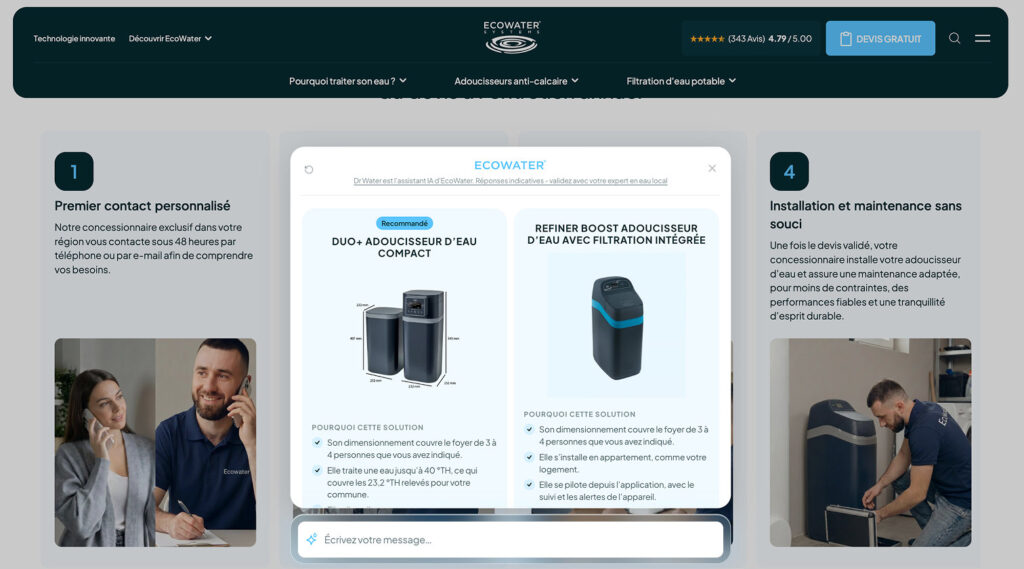
It follows your sales logic: compatibility rules, promotions based on the customer’s profile, a different range by country or state, priority on high-margin or in-stock products.
It plugs into your data wherever it lives, whether your store runs on Shopify, WooCommerce, BigCommerce, Adobe Commerce or a proprietary platform, and whether your information comes from an ERP, a PIM, a CRM or a reviews tool. You don’t have to move everything into one ecosystem.
Finally, you keep improving it, with no ceiling set by a subscription. You A/B test questions, widgets and messages, track the metrics you choose, analyze visitors’ real questions and switch AI models when another one offers better quality for the cost.
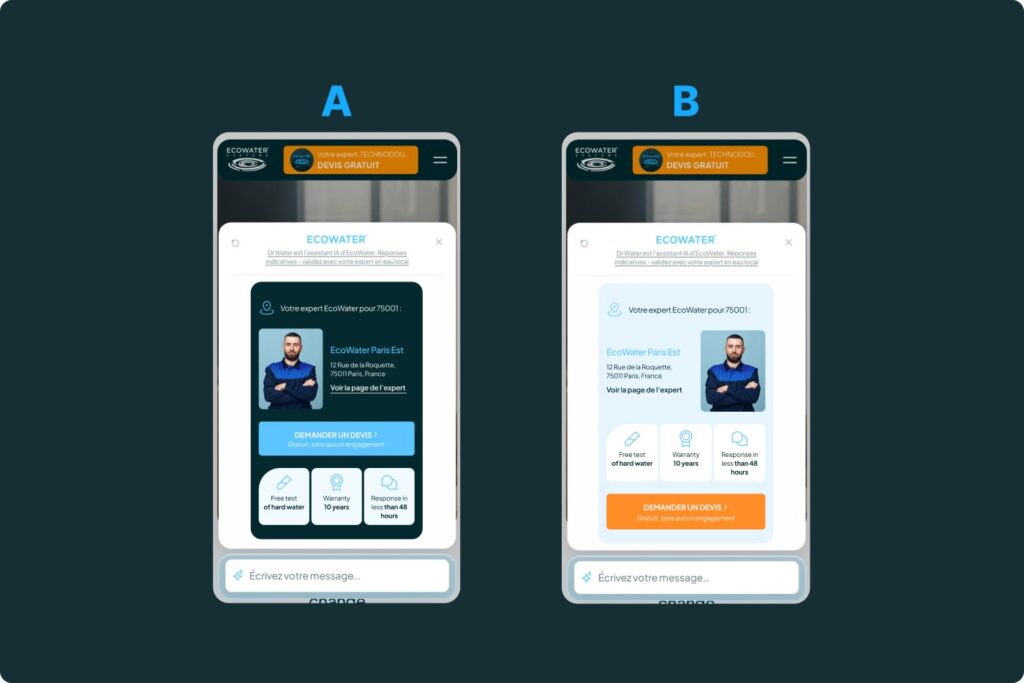
Custom design for your AI chatbot
Off-the-shelf tools usually offer a standard chat window that you dress up with your colors, logo, button position, an avatar and sometimes a CSS stylesheet. The structure generally stays the vendor’s. At Klaviyo, for example, custom CSS changes how the chat looks, but not its structure or its wording (Klaviyo documentation).
With a custom chatbot, the interface is designed like the rest of the site. The chatbot can open full screen on a buying guide page, sit inside a product page, guide a configurator or take the shape of a conversational quiz, instead of waiting in a bubble in the bottom-right corner. It uses your fonts, animations and product components, so the shopper stays in your brand’s world for the whole conversation.
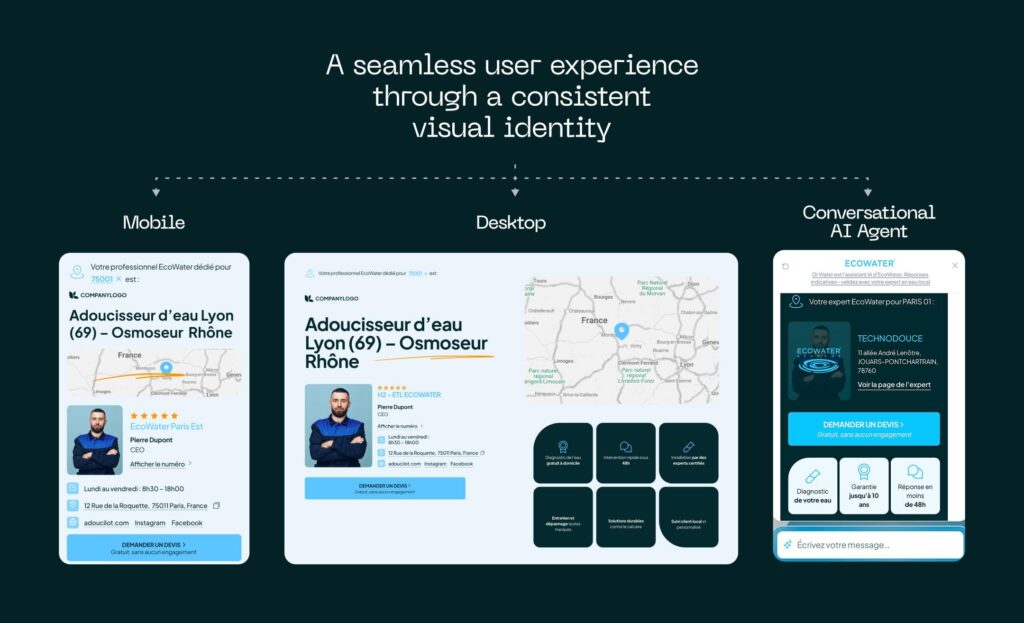
If your brand calls for it, the experience can go further with an immersive design: a 3D environment, animated transitions, products showcased during the conversation. The AI’s answers can even drive a 3D avatar, with its own voice, expressions and gestures, that welcomes and advises shoppers around the clock.
Interactive and immersive websites are Colibrity’s original expertise. We bring that know-how to AI chatbots so that talking to the AI makes people want to go all the way to checkout.
Klaviyo, Salesforce, Gorgias, Rep AI: how the off-the-shelf tools stack up
There are two kinds of tools. Klaviyo, Salesforce and Gorgias build their agent into a CRM or a helpdesk, which makes them effective when your data already lives there. Rep AI is a standalone AI shopping assistant for Shopify.
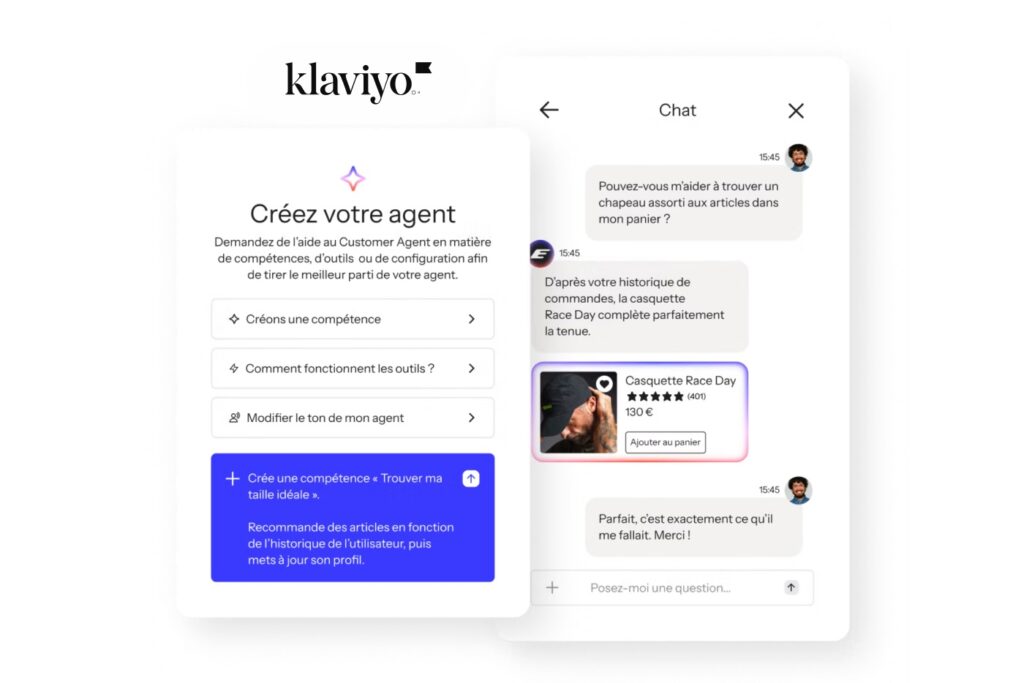
Klaviyo Customer Agent
Klaviyo, the B2C CRM with more than 205,000 paying customers, launched its AI agent, Customer Agent (also called K:AI Customer Agent), in September 2025. The agent learns from your store, your policies and your help center, and it draws on each shopper’s Klaviyo profile. It recommends products based on that profile and the shopper’s history, adds items to the cart, applies promotions, tracks orders, and handles returns and subscriptions. It replies by chat, email, SMS and WhatsApp, in the shopper’s language (113 languages), although Klaviyo recommends writing knowledge content in English (Klaviyo documentation).
The agent stays inside the Klaviyo ecosystem. What it can do depends on the connected tools (returns, subscriptions, loyalty), and fully custom tools are in a closed beta for a small set of brands. It’s billed per resolution, with the first 50 free. All features are available on Shopify. On WooCommerce, the Customer Hub can host a chat tab with Customer Agent, without third-party order tracking, returns, reviews, loyalty or subscriptions. On other platforms, it answers by email and SMS, without product recommendations or order tracking (Klaviyo, Customer Hub for WooCommerce). It’s a fit for B2C brands already on Klaviyo, including very large ones, whose buying journey goes from search to recommendation to cart.
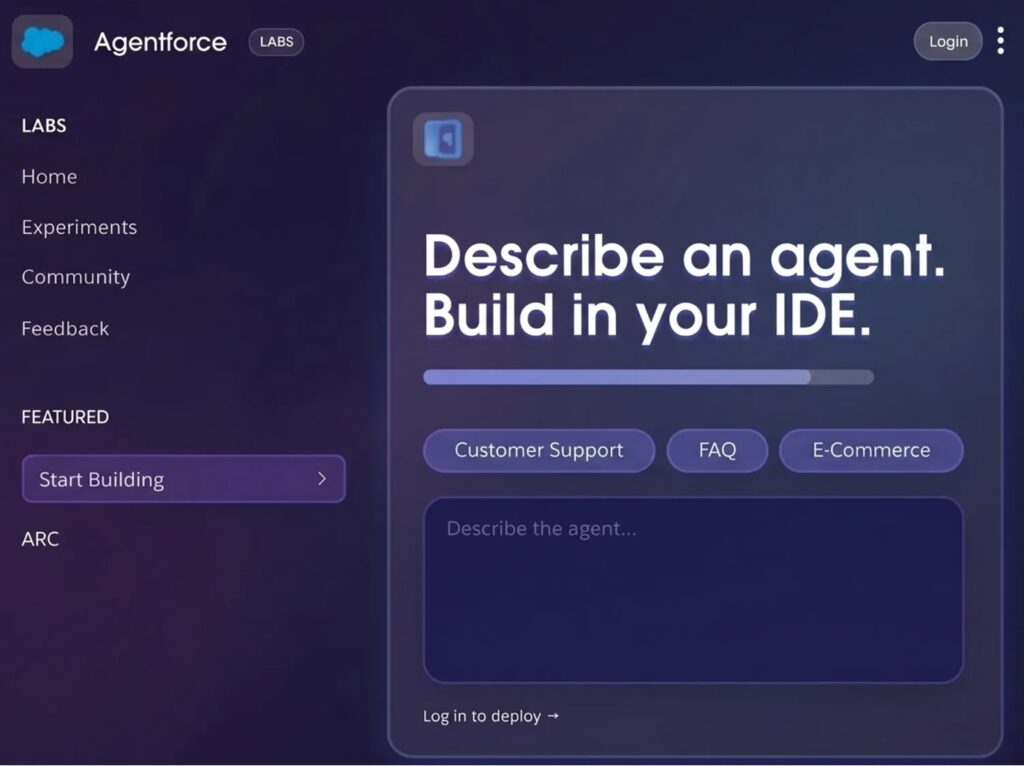
Salesforce Agentforce
Agentforce brings together Salesforce’s AI agents. On Commerce Cloud, the Shopper Agent (Agentforce Guided Shopping) answers store and product questions, recommends products and takes the shopper all the way to checkout in the chat, with Apple Pay and Google Pay. In B2B, Agentforce Guided Buying lets buyers find, purchase or reorder products at pre-negotiated prices. It uses storefront activity and purchase history, on the site and on messaging apps. Model choice is limited for the agent itself (Salesforce-managed models, including GPT, Claude and Gemini), and bring-your-own LLMs mainly serve custom actions and prompt templates (supported models).
You need to be in the Salesforce ecosystem: Commerce Cloud with the matching Agentforce licenses. Billing is usage-based, and the chat interface is customized through Salesforce development (Lightning components) (documentation). It’s the logical choice for retailers whose store already runs on Salesforce’s ecommerce platform.
Gorgias Shopping Assistant
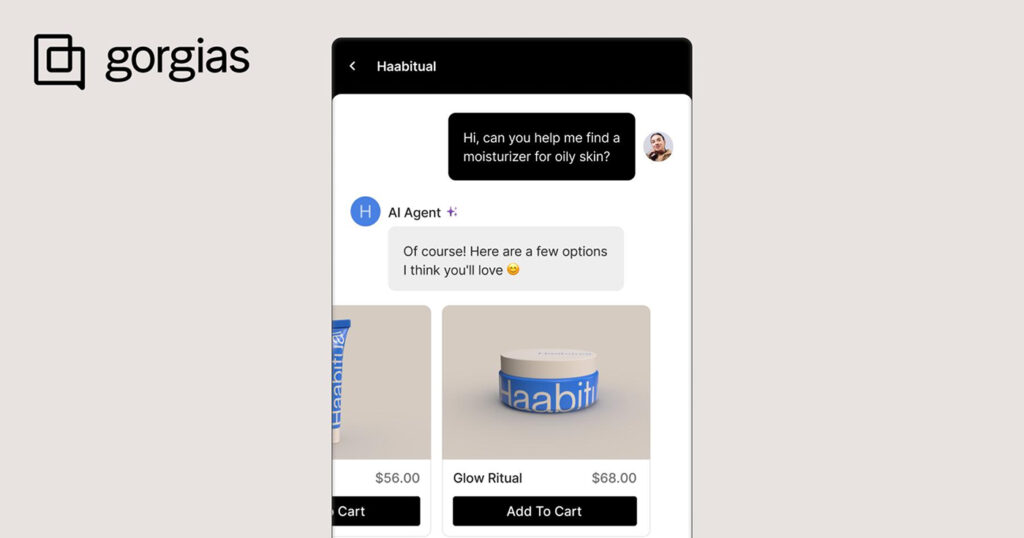
Gorgias is an ecommerce helpdesk. Its AI Agent includes a “Shopping Assistant” role that proactively engages visitors, answers their questions, recommends products and offers discounts. You set its selling style (Educational, Moderate or Promotional), its discount strategy and the products to promote or exclude. It works over chat, email and SMS.
It works with Shopify stores connected to Gorgias (no other platform is documented for the Shopping Assistant) and focuses on pre-purchase. It’s mainly for Shopify brands that already run customer service in Gorgias.
Rep AI
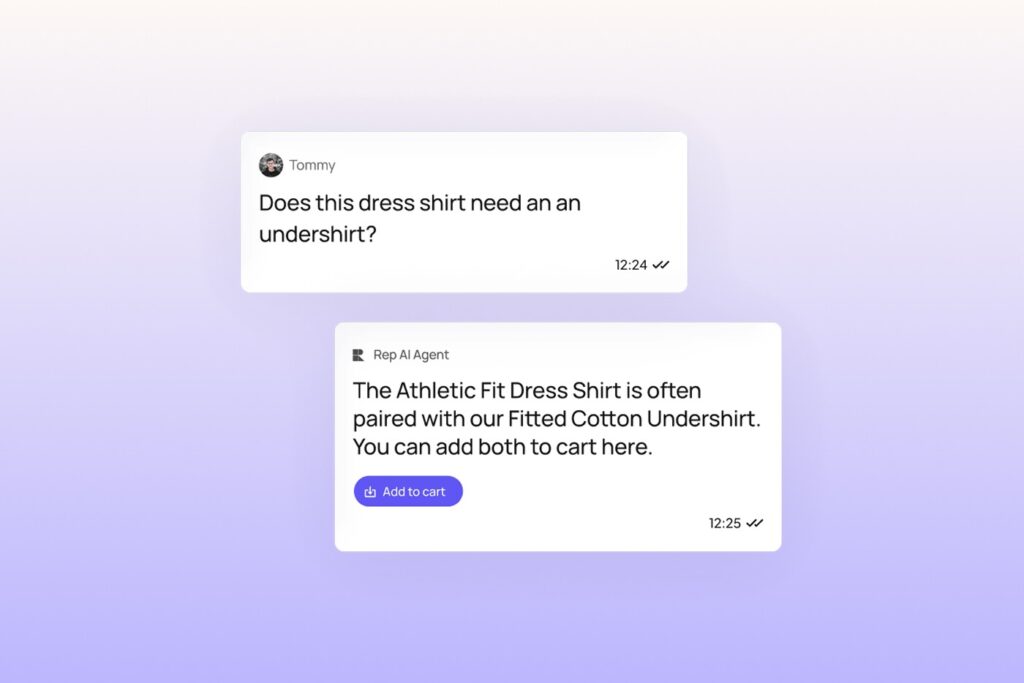
Rep AI is a New York-based AI shopping assistant for Shopify. It spots hesitant shoppers from their behavior and opens the conversation, then recommends products, answers FAQs, gives order status, handles returns, recovers carts and offers discounts, upsells and cross-sells. Pricing is based on monthly visitors, with a free plan for small stores. You customize colors, fonts, the chat window, welcome messages, chat flows and the agent’s avatar, and its analytics include A/B testing and funnel performance.
Rep AI works only on Shopify stores (Rep AI help center). It’s a fit for Shopify brands that want a proactive AI sales assistant without changing CRM or helpdesk.
Detailed comparison
| Criteria | Custom AI chatbot | Klaviyo | Salesforce Agentforce | Gorgias | Rep AI |
|---|---|---|---|---|---|
| Sales logic | Yours, defined with you | Klaviyo skills + connected tools (custom tools in closed beta) | Configured in Salesforce | 3 selling styles and an adjustable discount strategy | Chat flows, discounts, upsell and cross-sell settings |
| Widgets in the chat | Designed for your journey | Product recommendations in the chat (Klaviyo interface) | Native product display, customizable through development | Product recommendations, AI FAQs on product pages | Product recommendations, upsell pop-ups |
| Ecommerce platform | Any platform that exposes its catalog and cart through an API | Shopify (all features); WooCommerce via the Customer Hub, with fewer features; email and SMS only elsewhere | Salesforce Commerce Cloud (B2C and B2B) | Shopify (only platform documented) | Shopify only |
| Data used | Your sources (ERP, PIM, CRM…) through their APIs | Klaviyo profiles, site content, integrations | Salesforce data (storefront activity, purchase history, catalog) | Shopify and Gorgias data | Shopify store data and shopper behavior |
| AI model | Your choice, switchable | Managed by Klaviyo | Salesforce-managed models; bring-your-own LLM mainly for custom actions | Managed by Gorgias | Managed by Rep AI |
| A/B tests and analytics | Easy A/B tests, fully customizable analytics | Klaviyo analytics (AI-generated sales, resolution rate, add-to-carts), test sidebar, no A/B testing documented | Reports and Testing Center (tests before launch) | Gorgias reports (influenced sales, conversion), no A/B testing documented | A/B testing, conversion and funnel analytics |
| Code and hosting | Your code (per contract), hosting of your choice | Vendor | Vendor | Vendor | Vendor |
| Time to launch | A few weeks (depending on scope) | Fast: automatic store import | A Salesforce project | Fast on Shopify, requires the Gorgias helpdesk | Fast: Shopify app |
| Design and experience | Custom UI and UX, built into pages, immersive design, 3D avatar depending on the project | Colors, fonts and position without code, CSS for the rest; floating widget or Customer Hub tab | Salesforce chat customized through development | Color, logo, launcher, position, window size; advanced CSS by a developer | Colors, fonts, chat window, welcome messages, avatar |
Ecommerce chatbot: which option for which store?
Most off-the-shelf tools are quick to set up. To choose, look at how far each one follows your buying journey, your design and your data.
When to choose a custom AI chatbot
The chatbot applies your sales logic, its interface is designed for your site (all the way to immersive design or a 3D avatar), it connects to your tools whatever they are, and you stay in control of A/B tests, analytics, code and hosting. It’s the right choice if your products need expert advice (technical or configurable products, compatibility questions), if you sell in several countries or states with different rules, if your data is spread across several tools, or if the shopping experience is part of your brand image. Plan for a few weeks of design and development and an upfront budget.
When to choose Klaviyo Customer Agent
The agent is quick to set up: it imports your store content on its own, personalizes recommendations with Klaviyo profiles and brings email, SMS and chat together in one tool. It’s a fit if your marketing already runs on Klaviyo, or if you want a single platform for CRM, campaigns and the AI agent. A custom build becomes worth it when you want a chat experience that sets you apart, business-specific widgets or sales logic that Klaviyo’s skills don’t cover.
When to choose Salesforce Agentforce
Agentforce brings the depth of Salesforce data, in B2C as in B2B (negotiated prices, reorders), with agents for sales and for service. It makes sense if your store and customer data are already on Salesforce and you work with a Salesforce team or partner. A custom build takes over when the interface and the journey have to go beyond Salesforce’s framework, without depending on its development.
When to choose Gorgias
The Shopping Assistant is part of Gorgias’s AI Agent (accounts set up before May 28, 2025 may need to upgrade), billed per resolution on top of the helpdesk subscription. Its selling style and discounts are adjustable, and the same tool handles pre-sales and customer service. It’s a fit if you’re on Shopify and your customer service runs (or will run) in Gorgias. On another platform, or when advice takes more than a recommendation and a discount, a custom build is a better fit.
When to choose Rep AI
Rep AI is a proactive AI sales assistant built for Shopify, with built-in A/B testing and a free plan to get started. It’s a fit if you’re on Shopify and want an assistant that reaches out to hesitant shoppers without changing your other tools. A custom build takes over when you sell on another platform, when the sale goes through a quote, an appointment or a configuration, or when the design of the experience matters as much as the recommendation.
When to choose Shopify Inbox
Shopify Inbox is free and connects automatically to your store’s catalog, inventory and policies (Basic, Grow, Advanced and Plus plans, with new customer accounts). Its AI agent replies in the shopper’s language and can add products to the cart. It’s a good first step if you’re on Shopify and want to try an AI sales assistant without investing. A custom build takes over when you want to go beyond answers and recommendations, with your own rules, screens and integrations.
Your site doesn’t sell online? Read our comparison AI chatbot for brand and catalog websites.
FAQ
Is an off-the-shelf ecommerce chatbot enough for a large brand? Yes, if your buying journey follows the usual pattern: Klaviyo and Salesforce power some very large brands. A custom build becomes relevant when your journey, your data or your brand experience go beyond what the tool allows.
What’s the best AI chatbot for Shopify? Shopify offers Shopify Inbox for free, an AI sales associate that answers questions, recommends products from your catalog and can add them to the cart, in the shopper’s language. Klaviyo, Gorgias and Rep AI also integrate with Shopify, and so does a custom chatbot, which adds your own widgets and rules.
What about WooCommerce or BigCommerce? Shopify Inbox is Shopify-only, and Gorgias and Rep AI document their shopping assistants for Shopify only. Klaviyo offers its agent in the Customer Hub chat on WooCommerce, with fewer features than on Shopify. Some standalone tools, like Tidio Lyro (WooCommerce) or Alhena AI (WooCommerce, BigCommerce, Magento), cover other platforms. On WooCommerce, BigCommerce or a proprietary platform, a custom chatbot plugs directly into your catalog and orders.
Can I keep my CRM and have a custom AI chatbot? Yes. A custom chatbot can read from and write to Klaviyo, Salesforce or HubSpot while following your own sales logic.
How much does an ecommerce AI chatbot cost? We break down the price ranges in How much does a custom AI chatbot cost?
Your custom ecommerce AI chatbot with Colibrity
Every project starts with discovery: your buying journey, your catalog, your sales rules and the tools to connect (platform, CRM, ERP). We then design the chatbot, its widgets, its design and its logic, and keep improving it based on your customers’ real questions and A/B tests. Tell us about your store, and we’ll tell you whether a custom build is right for you.
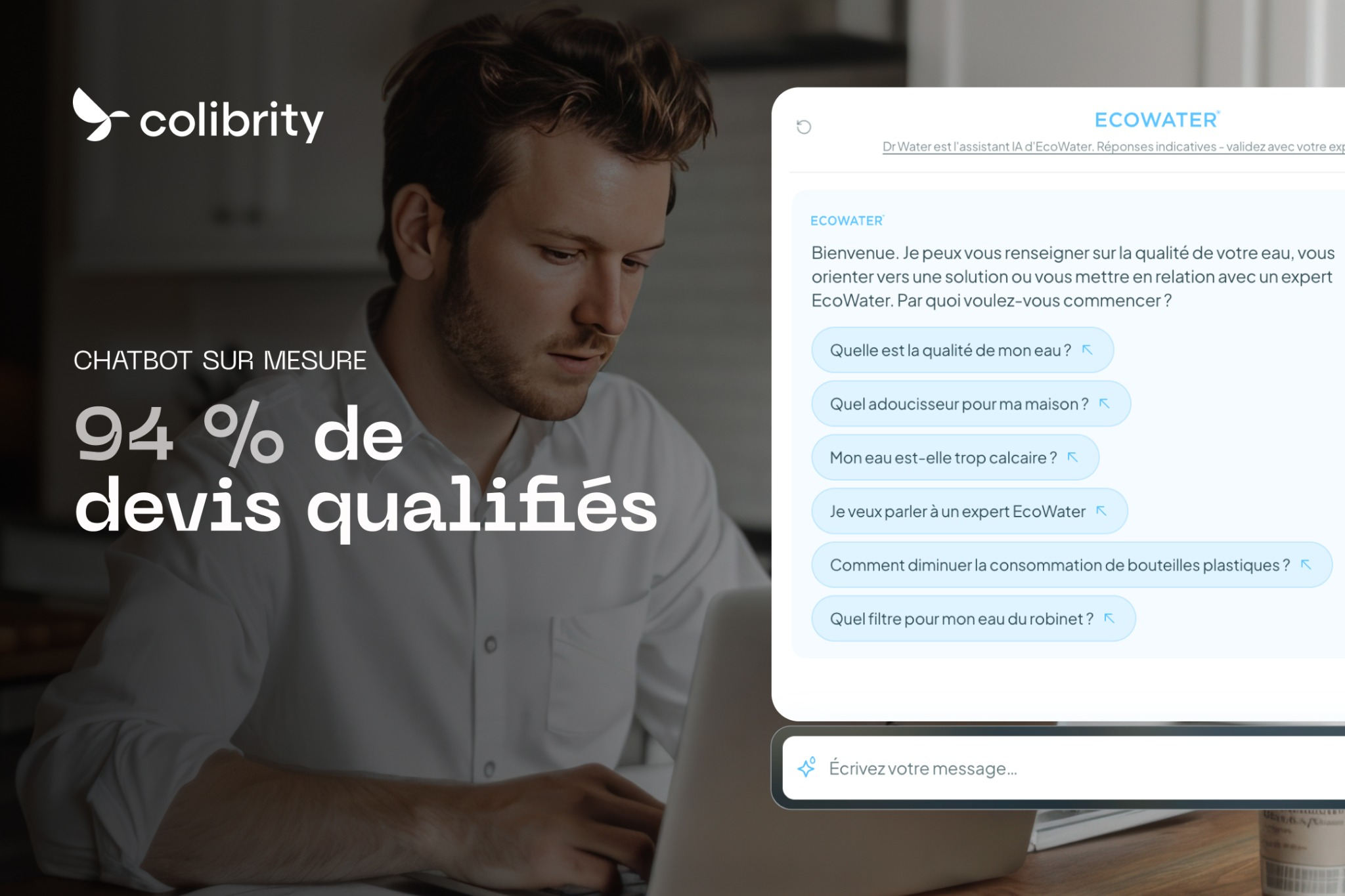
Want to see one in action? Read our EcoWater custom AI chatbot case study: nearly 9 in 10 quote requests sent through the chatbot are qualified.